

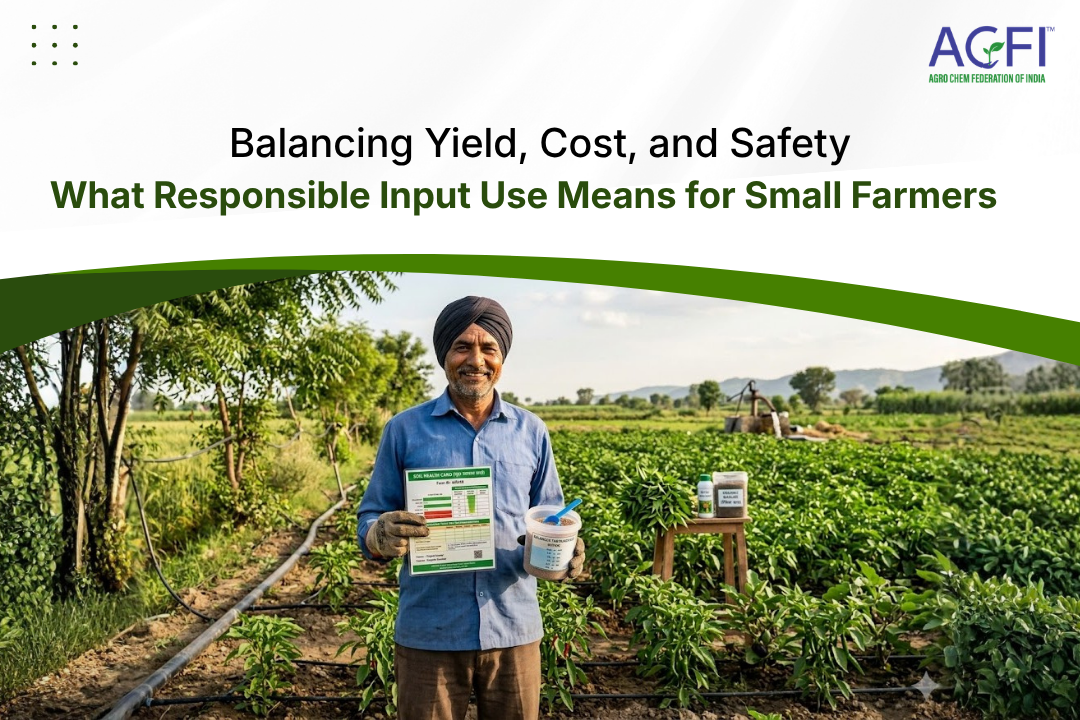
Balancing Yield, Cost, and Safety: What Responsible Input Use Means for Small Farmers
Responsible input use enables smallholder farmers in India, typically operating on holdings under 2 hectares, to achieve optimal crop yields, minimise expenditure through reduced wastage, and uphold safety standards for human health and environmental integrity, thereby ensuring long-term agricultural sustainability.
Precision Strategies for Yield Maximisation
Constituting 78% of India's farming population, smallholders often resort to excessive fertiliser and pesticide applications owing to resource constraints and informational deficits, resulting in 30-40% inefficiencies. Integrated Pest Management (IPM) integrates biological agents, crop rotation and economically threshold-driven chemical interventions, yielding 15-25% productivity gains while conserving pollinators and soil biota. State-issued soil health cards facilitate site-specific nutrient prescriptions, such as targeted zinc or phosphorus supplementation, thereby enhancing assimilation rates and limiting ecological leaching.
Expenditure Mitigation Approaches
Superfluous inputs erode the narrow profit margins of small farms, which account for 51% of national produce from 46% of arable land. Fractionated nitrogen regimens in wheat cultivation and neem-derived formulations diminish fertiliser outlays by 20-30% and pesticide requirements by 40%, as substantiated through controlled trials in Punjab and Maharashtra. Drip irrigation systems, incentivised under the Pradhan Mantri Krishi Sinchayee Yojana (PMKSY), achieve 30% water conservation, mitigate nutrient leaching, and enable eligibility for residue-compliant premium markets.
Safeguards for Health and Ecological Viability
Indiscriminate application results in residue exceedances beyond Maximum Residue Limits (MRLs), thereby impeding export competitiveness and groundwater salinisation. Strict adherence to product labelling, pre-harvest intervals, and the use of personal protective equipment protects agrarian communities and biodiversity. IPM protocols incorporating bio-inoculants such as Trichoderma reduce reliance on synthetic inputs, preserving edaphic fertility, which is indispensable for smallholders' predominance in 70% of high-value cropping systems.
Operational Recommendations
Small farmers are advised to adopt IPM via Krishi Vigyan Kendra-led demonstrations, procure complimentary soil health assessments, and conform rigorously to PPQS-mandated label specifications. Such measures consistently deliver 10-20% enhancements in net returns, fortifying adaptive capacity. Prudent input governance transmutes inherent limitations into strategic advantages, underpinning food security and economic upliftment within India's smallholder-dominated agrarian framework