

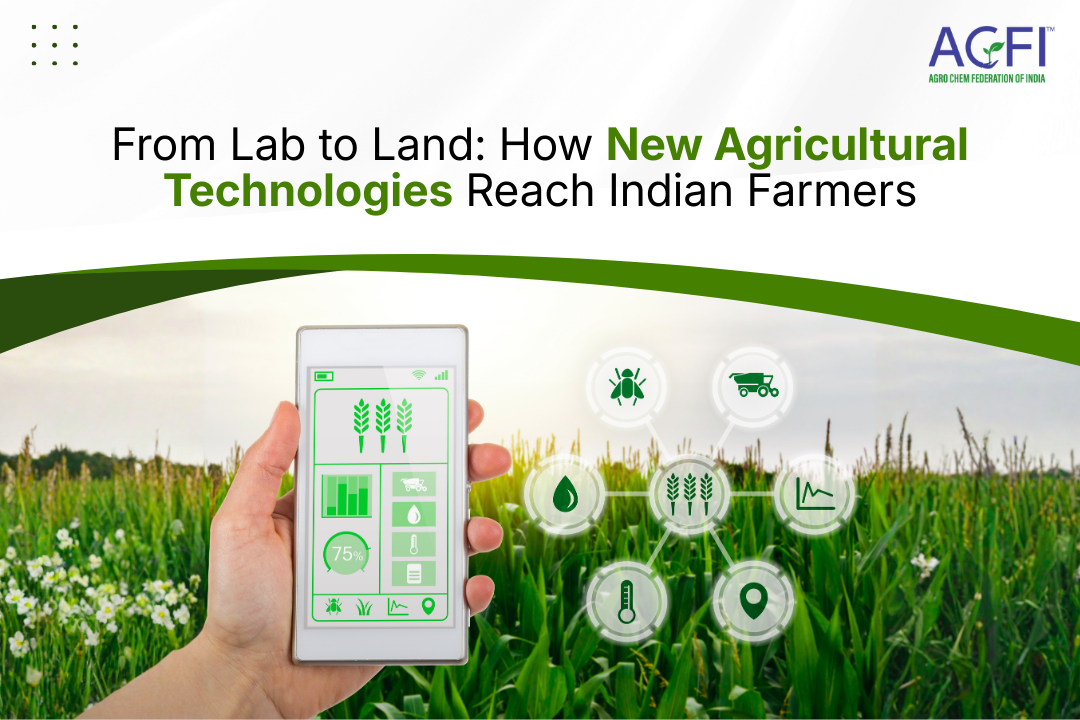
From Lab to Land: How New Agricultural Technologies Reach Indian Farmers
New agricultural technologies transition from laboratory innovation to widespread adoption
among farmers through structured pathways that involve research, validation, regulatory
approval, and extension services.
Research and Development Foundations
Indian institutions like ICAR and state agricultural universities spearhead R&D, developing crop varieties, biopesticides, and precision tools tailored to 15 agro-climatic zones. For instance, drought-tolerant wheat from the Borlaug Institute undergoes laboratory validation through multi-location trials before prototype scaling. Public-private partnerships accelerate this, with startups testing AI-driven apps on 10,000-hectare pilot farms.
Regulatory Validation and Scaling
Technologies undergo rigorous scrutiny by bodies such as GEAC for GM crops and CIB&RC for agrochemicals, to ensure safety and efficacy. Post-approval, ICAR's Krishi Vigyan Kendras
(KVKs) conduct on-farm demonstrations, with over 700 KVKs that trained 1.5 crore farmers in
2025 on drone spraying and soil sensors. Government schemes such as RKVY (Rashtriya
Krishi Vikas Yojana) fund scaling, subsidising 50% of the costs for smallholders to adopt micro-irrigation across 10 million hectares.
Extension and Digital Outreach
ATMA and mKisan platforms effectively bridge the gap between laboratory innovations and field application, delivering targeted SMS advisories on technologies such as variable-rate fertiliser application to the farmers nationwide. Agri-tech firms, through the Digital Agriculture Mission (DAM), integrate IoT sensors and AI platforms, reaching 14% of farmers by 2026 despite 86% exclusion of smallholders. FPOs pool resources to deploy shared drones, thereby boosting adoption in rainfed areas.
Impact and Future Pathways
Precision technologies have accelerated adoption by 25% annually, reducing input costs by
20% and increasing yields by 15% in leading states like Maharashtra and Punjab, as evidenced by pilot implementations. Despite persistent challenges, including digital literacy barriers among smallholders, NITI Aayog advocates integrated ecosystems to broaden access beyond the current 14% penetration rate. Farmers can readily engage through Krishi Vigyan Kendras for demonstrations, download apps such as Kisan Suvidha for real-time guidance, or apply for SMAM subsidies covering up to 50% of equipment costs, thereby streamlining the process from laboratory breakthroughs to field-level transformation for resilient, high-productivity agriculture.