

Pest Surveillance in Indian Agriculture: Moving from Late Response to Early Preparedness
The farmer walks into the field in the morning, the crop looks right from a distance and then senses something wrong upon getting closer, which is a moment that almost every Indian farmer has experienced. Leaves with holes. Stems that have wilted overnight. A patch of discolouration was spreading across rows that looked healthy just days ago. The damage is already done, and the scramble begins: to identify what it is, to find the right product, to apply it quickly enough to save what remains. It is a stressful, costly, and deeply familiar experience. And in many cases, it was avoidable. The pest was there before the damage showed. It just was not seen in time.
The Real Problem: We Respond When We Should Be Prepared
Across Indian agriculture, late pest detection is one of the most consistent causes of avoidable crop losses. The problem is not that farmers are inattentive. Farmers know their fields intimately. The problem is that pest monitoring is rarely treated as a structured, regular activity. It tends to happen in response to visible damage rather than in anticipation of it. By the time an infestation is obvious, it has typically been building for days or even weeks. The window for an early, low-cost, highly effective response has already closed. What follows is a reactive intervention that costs more, works less, and rarely recovers the full crop.
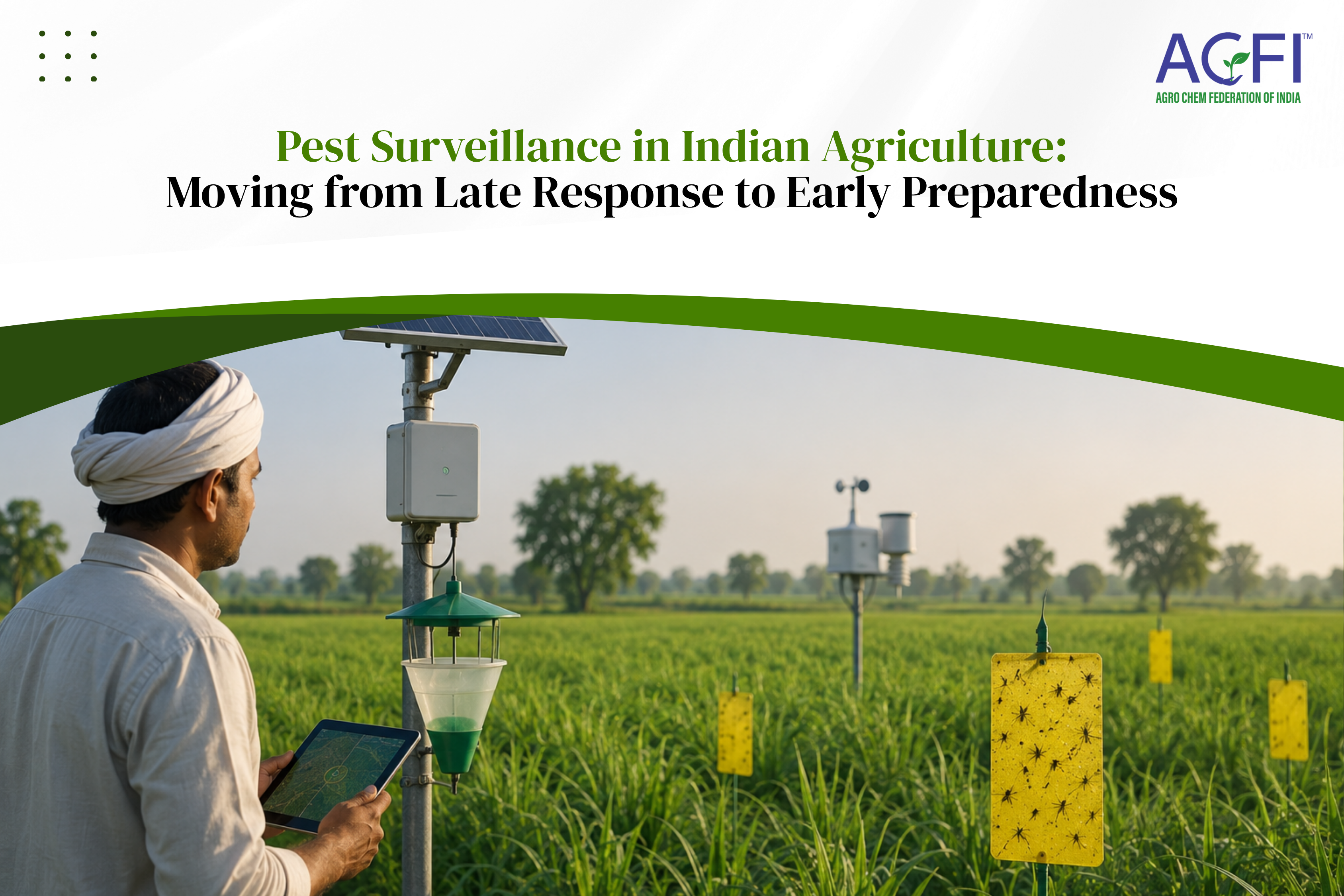
Pest surveillance does not require sophisticated equipment or specialised training to begin. Practically, it means walking the field at regular intervals, every few days during vulnerable crop stages and looking deliberately at leaves, stems, soil, and shoots for early signs of pest activity. It means using simple tools where available: sticky traps that catch insects before populations build, pheromone lures that signal the presence of specific pests, or light traps that track nocturnal activity. It means knowing what pests are common in your region at each crop stage, so that what you are looking for is specific rather than general. The habit of looking carefully and consistently is itself a form of protection.
Identification Matters as Much as Detection
Catching something early only helps if it is identified correctly. Many crop losses are made worse not just by late detection but by misdiagnosis, treating for the wrong pest, applying the wrong product, and losing both time and money in the process. Correct identification is what turns an early sighting into an effective response. Today, mobile-based diagnostic tools and image-recognition platforms are making it easier than ever for farmers to quickly identify pests without waiting for an expert to travel to the field. A photograph, a platform, and a prompt response can compress what used to take days into hours.
The Power of Shared Observation
Pest pressure rarely stays contained to a single field. When one farm shows signs of an infestation, the farms around it are often at risk within days. This is why community-level surveillance is so valuable. When farmers share what they are observing, even informally, through a WhatsApp group or a conversation at the market, early warnings can reach neighbours before the pest does. Local agricultural offices, input dealers, and extension networks play an important role in translating these field-level observations into broader advisories, helping entire clusters of farmers respond together rather than each one discovering the problem independently and too late.
Conclusion: Readiness Is Real Crop Protection
Pest surveillance is basically about shifting the farmer's relationship with their field, from reaction to readiness. It does not demand expensive technology or complex systems. It demands observation, consistency, and the willingness to act on early information rather than waiting until the damage is undeniable. In an environment where climate variability is making pest behaviour increasingly unpredictable, that readiness is not a luxury. It is one of the most practical and powerful investments a farmer can make. The crop that is watched carefully is the one that is protected well, and the farmer who checks on it early is the one who spends less, loses less, and harvests more.