

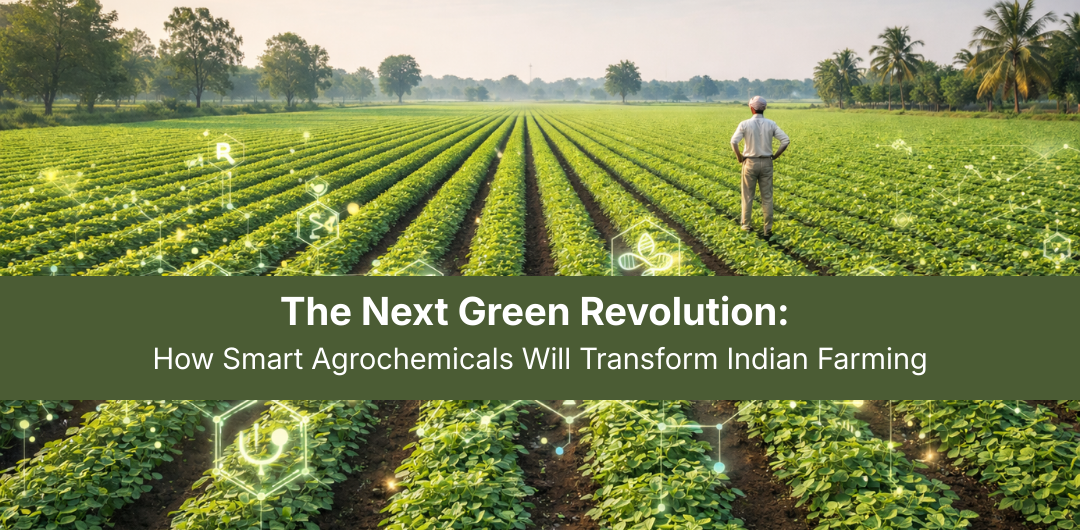
The Next Green Revolution: How Smart Agrochemicals Will Transform Indian Farming
The next Green Revolution in India will be driven not only by seeds and irrigation, but by “smart” agrochemicals used with precision, data and digital tools to boost yields while cutting environmental footprint. Instead of more chemicals, the focus will be on better molecules, better timing and better targeting.
Shift from heavy use to smart use
In the first Green Revolution, India used high-yielding seeds, irrigation and large amounts of fertilizers and pesticides to increase production. This helped the country achieve food security, but it also caused problems like poor soil health, polluted water and resistance in pests and weeds. Today, farmers face new challenges like climate change, shrinking landholdings and rising input costs, so simply increasing chemical use is not the answer.
Now the focus is shifting from using more chemicals to using them smartly. The idea is to use science, data and technology to decide what to spray, how much to spray and where and when to spray it on the field. This can protect the crop effectively, reduce wastage and save money for farmers.
What are smart agrochemicals?
Smart agrochemicals are improved versions of fertilizers and pesticides that are designed to work better with lower doses. They may include:
- Low-dose, high-efficiency pesticides and herbicides.
- Nano-formulations and slow-release products that release nutrients or active ingredients gradually.
- Biological and bio-based products, which are safer for humans and the environment.
These products often stick better to leaves, dissolve more easily in water and release their active ingredient slowly over time. Because of this, farmers can use less quantity per acre and still get good control of pests or good nutrition for crops.
How technology makes them “smart”
Smart agrochemicals become truly powerful when they are used with digital and precision farming tools. For example:
- Sensors placed in the field can measure soil moisture, crop growth and pest risk, helping decide when spraying is actually needed.
- Drones and satellite images can show which parts of the field are stressed or infected, so chemicals are sprayed only in those patches and not everywhere.
- Mobile apps and AI-based advisory platforms can guide farmers on pest identification, correct dose, spray timing and safety measures in simple local languages.
This type of targeted spraying reduces unnecessary use of chemicals, lowers costs and decreases the chances of residues and pollution.
Benefits for farmers and the environment
Using smart agrochemicals with precision tools can bring multiple benefits:
- Higher productivity: Better timing and targeting of sprays help reduce crop losses from pests and diseases, leading to higher yields.
- Lower costs: Farmers can reduce wastage of agrochemicals and use lower doses, which save money on inputs.
- Safer environment: Because chemicals are used only where needed and in smaller amounts, there is less run-off into water bodies and less impact on beneficial insects and soil life.
- Improved resilience: Healthy soils and balanced use of inputs make crops more resilient to climate stress like droughts, floods and new pest outbreaks.
If widely adopted, such practices can support India’s goal of producing more food with less water, less land and fewer emissions.
What needs to change to enable this?
For smart agrochemicals to truly transform Indian farming, several things must happen together:
- Companies and start-ups must develop and supply newer, safer formulations and precision spraying services suited to small and marginal farmers.
- Policies and regulations should support technologies like drone-based spraying and faster approval of low-risk and bio-based products, while ensuring strict safety standards.
- Extension systems, FPOs, cooperatives and NGOs should train farmers in simple ways on how to use these products, how to read labels and how to follow resistance management practices.
- Digital infrastructure in rural areas, such as smartphones, connectivity and local-language apps must be strengthened so that farmers can access real-time advisory.
- Public-Private Partnerships (PPPs) must be scaled up to co-fund R&D, pilot demonstrations and last-mile delivery of smart agrochemicals through models like those under the National Mission on Sustainable Agriculture.
Brought together, these elements can turn smart agrochemicals into a true engine of India’s next Green Revolution, delivering more food from fewer resources, strengthening farm livelihoods and safeguarding soil, water and climate for future generations.